
Dialogues (feat. Others)
A "New" Approach to Writing Discussions

The Old Inklings
For several years now, I’ve wanted my own group of Inklings.
If you are unfamiliar, the Inklings were a group of scholars, writers, philosophers, lay Christians, and professors who met at Oxford in the 1930s and 1940s. The group had a flexible membership, with two notable members: C.S. Lewis and J.R.R. Tolkien.
Some nights the group would talk about ideas.
Some nights they would read selections from their works in progress.
Some nights they would just chat about the world.
When I applied for a graduate program in Creative Writing, I thought that I would find my Inklings. I found good peers, but not anyone that wanted to discuss topics as wide as philosophy, theology, the craft of storytelling. I admit, I was disappointed.
When I began teaching university courses, I started a group at my university called “The Writer’s Hour,” where anyone could drop in to a large conference room I’d reserved for two hours. I created a list of interesting discussion topics, hoping to help teach the importance of healthy and respectful disagreement, how to develop the ideas we were presenting in our creative works. A few students came each week, but they primarily wanted help polishing their current projects. No one ever took me up on the offer to start a conversation, and no other professors came.
Again, I was disappointed.
In the past few months, though, I’ve come to a realization about why the Inklings worked. Why they formed, why they continued meeting.
Ultimately, it comes down to the fact that they were willing to share their incomplete work. The unfinished Lord of the Rings. Essays by Lewis. Unrefined ideas about God and the universe, or language and how it constructs perspective.
Their imperfect ideas and writings were flexible. They allowed room for dialogue.
Now, going back to my previous instances of trying to find “my Inklings,” I’m not saying that the world I or my peers produced in my MFA program were perfect. Far from it. But I do think that we were trying to present an image of perfection. Or we were trying to have the perfect beliefs, the perfect set of ideologies that would be accepted within academia, no matter how we felt in reality.
We were trying to present the stories we thought everyone expected. Or we were writing with the express purpose of going against the grain, which just ended up being what everyone else expected.
To aim for the perception of perfection in writing and thought is stunting. Instead, I think that we (like the Inklings) must instead aim for genuine growth, which can only come as we are willing to expose our egos to the elements of dialogue.
We must reject the fear of incompletion.
Coming to this realization, I’m trying to take a “new” approach to my writing, especially the writing that I share publicly. Rather than creating perfect drafts that express—without fault—my ideas exactly as I hold them in my head, I am trying to allow my writing into the world before they have the appearance of being fully formed. I’m letting imperfections (or incompletions) allow room for growth.
As someone who really likes to control how other people perceive me, this is difficult.
But incompletion provides others with a chance to approach us. It opens up new conversations, allows us to refine our ideas, and gives us opportunities to meet with people, to hear from them. To sit around a physical or metaphorical fireplace and discuss the nature of reality, the purpose of storytelling.
Incompletion in Practice
I’ve already started to see some results from attempting this method in my most recent article, The Semantics of Reality w/ Carl Rogers.
The following day at midnight, I received a text from my friend who was mentioned at the beginning of that article (it was based on a conversation we had):
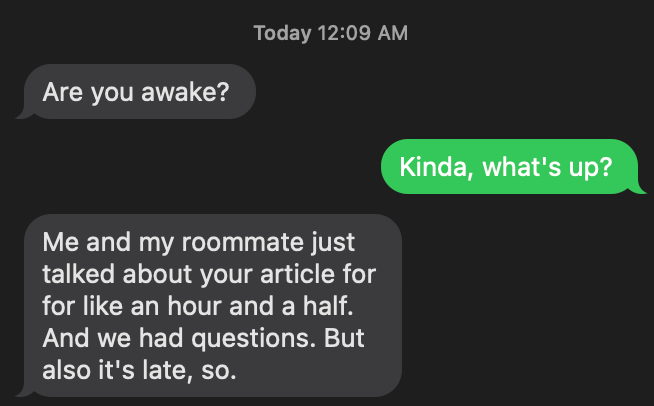
I have yet to find time to meet in-person with this friend, but I’m really eager to hear about his discussion and questions about the article.
Then another friend of mine wrote a response article, where he also disagrees with Rogers though in a far more humorous and offense-based manner. Maybe “offensive” works there, I don’t think Boo would mind. In any case, you can read that article by clicking here, where he also discusses his understanding of Absolute Reality.
Another long-time friend messaged me with a critique1:
The overall idea and premise seemed pretty interesting, but it was pretty obvious from reading that you had no outline and no real agenda when writing it. I kept waiting for the “so what” and while you did have an application section, I’m not sure anything in there was not already obvious to any decent human being.
Which is completely fair! In a society where most people go to school for 16+ years, we’re used to having a straightforward point to the things we read. We want an agenda when we read things, and we want that agenda to be made clear from the structure. But I’m not sure the Inklings always had an agenda when they were meeting together. Sometimes, writing and dialogue can simply have the overarching and decades-long “point” of growth, starting conversations.
Sometimes we micromanage ourselves out of real engagement with each other.
Thankfully, this wasn’t the case with my friend who sent me the message. We had a great conversation following this, discussing whether or not it is valuable for people to believe in an Absolute Truth, or if someone who doesn’t believe in Absolute Truth can be just as fulfilled. We also ended up talking about faith, different definitions of it and how it is impacted by our understanding of Truth.
My friend ended the conversation with this opinion:
Now I do think having a correct view will aid in your quest to build faith, and I believe that Absolute Truth is the correct view. So from a personal level I would try to persuade others to believe in an Absolute Truth. But from an academic standpoint I still kinda see every approach as equal.
Indeed, but the weight of that final statement doesn’t rest on absolute truth, but rather on the value that we give “academics.” Is the purpose of academic study to gain knowledge? If so, then recognizing and seeking an Absolute truth is important. Is the purpose of academic study to improve the world? If so, then recognizing Absolute Truth and how our alignment with it can make us happier is important. Western academia was originally built on the concept that there was Absolute Truth, that the universe was created and therefore study-able understandable.
But I digress. The point is that my incomplete writing sparked a great conversation.
The New Inklings
My Inklings don’t meet in a pub called the Eagle and Child.
They don’t meet in my office, or the room I reserved to try and recreate them.
My Inklings aren’t friends with each other (yet). They come from different cities, different backgrounds. They come out of the woodwork when I’m willing to share incomplete things. But they are providing much needed conversations about truth, craft, and theory that are helping me to grow.
Here is a fireplace. Share your incomplete work. And talk.
I did ask for his permission before sharing this conversation!
To be fair, unfinished (and at times deeply embarrassing) story snippets were shared in said writers hour, so creating the space did work to some extent.
Though I think the lack of fireplace is what really kept it from reaching full potential.